Life Happens in an Elevator in an Elevator in an Elevator

- Home
- About Us
- Products/Services
By Industry
Service & Modernisation
- Architects & Designers
- By Industry
- Blogs
- Contact Us
Home Elevator vs Stairlift: Which Is the Best Mobility Solution for Your Home?
As people grow older or develop mobility challenges, moving between floors can become difficult. Fortunately, modern homes have several accessibility options for home, including stairlifts, home elevators, and wheelchair lifts.
Among these, the choice often comes down to home elevator vs stairlift. Both solutions can make everyday movement easier, but they work differently and suit different needs.
So, which is the best mobility solution for home? Let’s compare the two and understand what you should consider before making a decision.
What Is a Home Elevator?
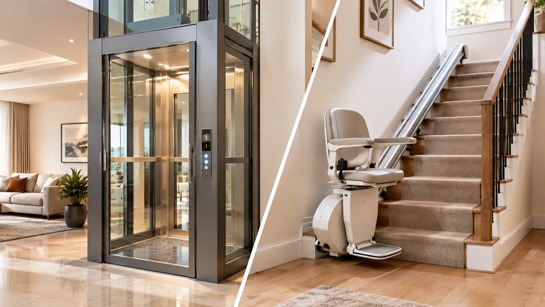
A home elevator is a compact vertical transportation system designed to move people between different floors of a house. Unlike traditional elevators found in commercial buildings, modern residential elevators can be designed specifically for homes with limited space.
A home elevator can be useful for:
- Elderly family members
- People with mobility limitations
- Wheelchair users
- Families living in multi-storey homes
- People who want convenient floor-to-floor access
A well-designed elevator can also add convenience for carrying groceries, luggage, or other items between floors.
What Is a Stairlift?
A stairlift is a motorized chair installed along a staircase. The user sits on the chair, which travels along a rail from one floor to another.
Stairlifts are generally suitable when:
- The main difficulty is climbing stairs
- A wheelchair is not required while travelling between floors
- There is an existing staircase suitable for installation
- The user wants a relatively simple mobility solution
Stairlifts can be particularly helpful for elderly individuals who find stairs tiring, painful, or unsafe.
Home Elevator vs Stairlift: Key Differences
While both systems improve accessibility, their functionality is quite different.
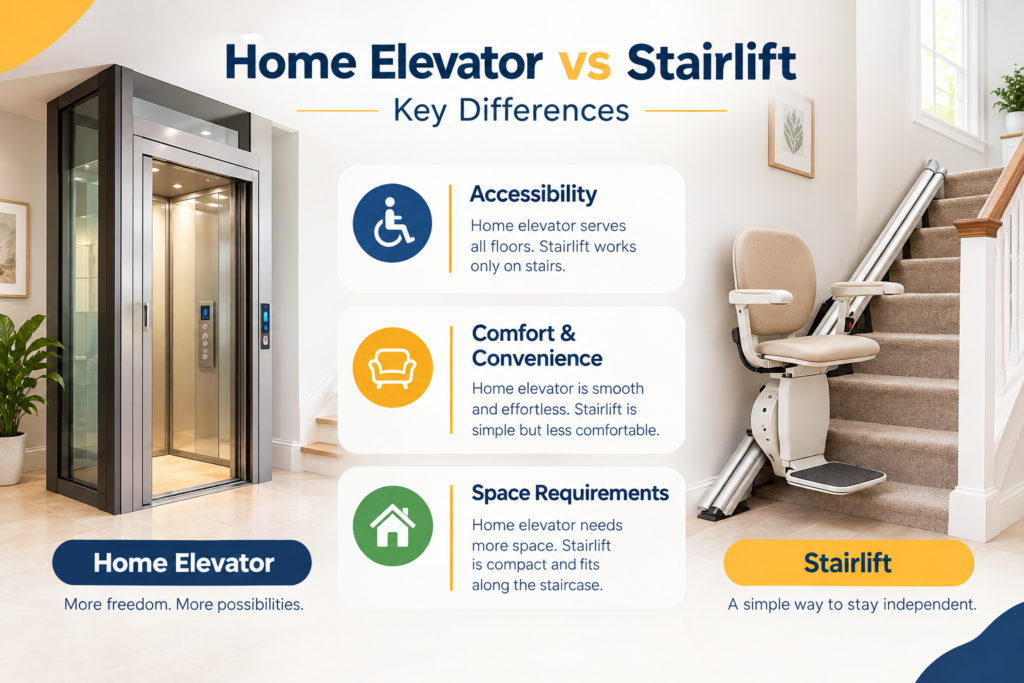
1. Accessibility
A home elevator generally provides broader accessibility because it can accommodate people standing, sitting, or using certain mobility aids, depending on the design and capacity.
A stairlift primarily transports one seated person along the staircase.
For households with different mobility requirements, a home elevator may provide greater flexibility.
2. Comfort and Convenience
A home elevator offers direct floor-to-floor transportation without requiring the user to transfer onto a stairlift chair.
It can also make everyday tasks easier by allowing users to transport:
- Wheelchairs or mobility aids
- Shopping bags
- Luggage
- Household items
A stairlift, meanwhile, is primarily designed around the user’s ability to transfer onto and off the seat.
3. Space Requirements
Stairlifts use the existing staircase and usually require less structural modification.
Home elevators may require more planning and available space, although modern residential elevator designs can be adapted to different home layouts.
Before selecting either option, consider the available space, staircase configuration, number of floors, and structural requirements.
Stairlift vs Home Elevator Cost
When comparing stairlift vs home elevator cost, there is no single price that applies to every home.
The final cost can depend on factors such as:
- Type and specifications of the system
- Number of floors
- Installation requirements
- Available space
- Capacity
- Customization
- Structural modifications
- Safety and control features
A stairlift may have a lower initial installation cost in many situations because it uses the existing staircase. A home elevator can involve a larger investment, but it provides a different level of accessibility and can serve multiple purposes.
Therefore, cost should be considered alongside long-term usability rather than being the only deciding factor.
Home Elevator for Elderly: What Should You Consider?
For families looking for a home elevator for elderly parents or relatives, safety and ease of use should be major priorities.
Look for features such as:
- Easy-to-use controls
- Smooth starting and stopping
- Emergency safety mechanisms
- Adequate lighting
- Suitable cabin dimensions
- Reliable door systems
- Proper installation and maintenance support
It is also important to think about future needs. A mobility solution that works today should ideally remain practical if the user’s mobility requirements change later.
Wheelchair Lift vs Home Elevator
Another common comparison is wheelchair lift vs home elevator.
A wheelchair lift is specifically designed to help wheelchair users overcome vertical levels. It can be useful where wheelchair accessibility is the primary requirement.
A home elevator, on the other hand, can provide broader transportation for family members and may also accommodate wheelchair users depending on its size and configuration.
The right choice depends on:
- Wheelchair dimensions
- Available installation space
- Number of floors
- Frequency of use
- User requirements
- Home layout
How to Choose the Right Mobility Solution?
Before making a decision, ask yourself:
Who will use the system?
Consider elderly users, wheelchair users, children, and other family members.
What space is available?
Assess your staircase, floor area, and possible installation locations.
What is your budget?
Compare installation, maintenance, and long-term usability.
How many floors need to be connected?
A multi-floor home may benefit from a solution designed for regular vertical transportation.
What are your long-term needs?
Think beyond your current mobility requirements.
Choosing a Home Mobility Solution With Easa Elevators
Choosing between a stairlift and elevator is ultimately about finding a solution that fits your home’s layout, your family’s requirements, and your long-term accessibility needs.
Easa Elevators offers residential elevator solutions designed to make movement between floors more convenient and accessible. If you’re considering a home elevator, discussing your requirements with an experienced elevator provider can help you understand the available options, installation requirements, and suitable configuration for your home.

Final Thinking
The choice between a home elevator vs stairlift depends on individual mobility requirements, available space, budget, and long-term plans.
A stairlift can be a practical option for someone who primarily needs assistance using the stairs. A home elevator can provide broader floor-to-floor accessibility and may be more suitable for households looking for a long-term mobility solution.
Before making a decision, evaluate your home’s layout and the needs of everyone who will use the system. The right accessibility solution can make everyday movement safer, easier, and more convenient.